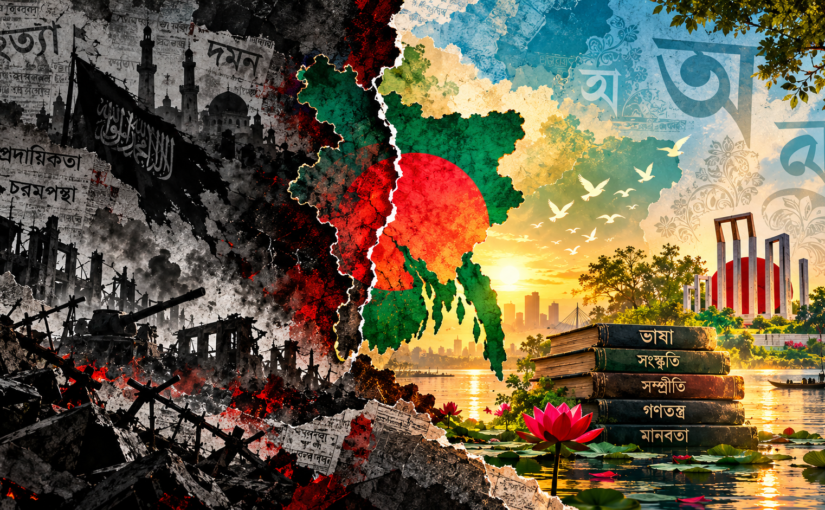
The 1971 Bangladesh Genocide and the Contemporary Threat to Progressive Muslim Identity
Introduction: A Nation Divided by Competing Visions
Bangladesh emerged in 1971 from one of the most devastating episodes of mass violence and genocide in South Asian history. Its independence represented more than the creation of a new sovereign state. It challenged the assumption that religion alone could provide a sufficient foundation for national identity, political unity and equal citizenship. The Liberation War in 1971 demonstrated that linguistic, cultural, political and economic rights could unite people across religious boundaries, even when they shared a religious identity with those exercising power over them.
More than five decades later, Bangladesh continues to confront fundamental questions about the relationship between religion, national identity and state authority. One of the most significant tensions lies between movements seeking to organise political and social life around restrictive interpretations of religion and those advocating an inclusive society based on equal citizenship, cultural freedom and respect for diversity.
This article argues that the persecution of progressive Muslims, secular intellectuals, religious minorities and advocates of equal rights must be understood within a longer historical struggle over the identity of Bangladesh. The conflict predates independence, acquired a particularly violent character during the 1971 genocide and continues to influence contemporary political and social relations.
The principal concern is not Islam as a religion. Rather, it is the political instrumentalisation of religious identity to justify exclusion, discrimination, intimidation and violence.
Two Competing Visions of Bangladesh
Contemporary Bangladesh contains diverse religious, cultural and political traditions. Nevertheless, two contrasting visions help explain an important dimension of its ideological tensions.
The first is an exclusionary vision in which political authority, national belonging and social legitimacy are defined through a restrictive interpretation of religious identity. At its most extreme, this ideology seeks to suppress dissent, subordinate women’s rights, reject religious pluralism and impose religious conformity through coercion.
Some violent extremist organisations regard alternative interpretations of Islam, secular political institutions and cultural practices associated with Bengali identity as threats to their ideological authority. Individuals who challenge these interpretations may be accused of apostasy, atheism or hostility towards religion.
The second vision is founded upon an inclusive understanding of citizenship. It encompasses progressive and moderate Muslims, secular thinkers, religious minorities, Indigenous peoples and other communities committed to coexistence and fundamental rights.
An important element of this second vision is the identity of the peaceful, progressive Muslim.
Such an individual may practise Islam, maintain strong religious convictions and respect Islamic traditions while supporting democracy, freedom of expression, women’s equality, cultural pluralism and the rights of other religious and minority communities.
Religious devotion and progressive social values are not inherently incompatible. Indeed, Bangladesh’s history contains numerous examples of Muslims who have defended Bengali language, literature, secular political institutions and inter-religious solidarity.
The distinction is therefore not between Muslims and non-Muslims, or between religion and irreligion. It concerns the political use of religious authority and the extent to which individuals are permitted to exercise their fundamental rights without coercion.
These visions should not be treated as two homogeneous populations. Religious conservatism does not necessarily imply support for extremism, and political Islam encompasses movements with different objectives and methods. The critical dividing line emerges when ideological beliefs are used to justify violence, persecution and the denial of equal citizenship.
The Historical Roots: Colonialism, Communal Politics and Partition
The ideological conflicts visible in contemporary Bangladesh cannot be understood without examining the political transformations of British India.
Before colonial rule, the Indian subcontinent experienced extended periods of cultural interaction among Hindu, Muslim, Buddhist and other communities. These relationships included cooperation, shared traditions, political competition and occasional religious conflict.
British colonial administration introduced new forms of political representation, economic organisation and population classification that subsequently influenced communal identities.
In Bengal, the Permanent Settlement of 1793 reshaped agrarian relationships and contributed to enduring inequalities between landlords and cultivators. These inequalities intersected with religious identity in complex ways, particularly in eastern Bengal (i.e., current Bangladesh), where many cultivators were Muslim.
During the late nineteenth and early twentieth centuries, political mobilisation increasingly drew upon religious classifications. The Partition of Bengal in 1905, the emergence of separate electorates and the growth of competing nationalist movements contributed to the political institutionalisation of communal identities.
The creation of Pakistan in 1947 represented a culmination of one influential strand of Muslim political nationalism. For many Bengali Muslims, Pakistan also represented the promise of political representation, economic opportunity and freedom from longstanding social inequalities.
Yet the new state soon revealed a profound contradiction.
Pakistan had been established in the name of Muslim political unity, but that shared religious identity did not guarantee political equality, cultural recognition or equitable access to state resources.
This contradiction became central to the subsequent history of East Pakistan.
From Religious Unity to Internal Domination: Pakistan, 1947–1971
Between 1947 and 1971, successive Pakistani governments faced growing opposition in East Pakistan over language, political representation, economic inequality and regional autonomy.
The attempt to establish Urdu as the principal symbol of Pakistani national unity was particularly significant. For Bengali-speaking citizens, the marginalisation of their mother tongue represented an attack on cultural recognition and political equality.
The Language Movement of 1952 demonstrated that Bengali Muslims could defend their linguistic and cultural identity while remaining committed to their religion.
This development exposed a fundamental weakness in the assumption that a shared religious identity could override cultural and regional differences.
Over the following two decades, economic disparities, unequal political representation, military dominance and restrictions on democratic participation intensified grievances in East Pakistan.
The refusal to transfer political power following the 1970 general election transformed these longstanding tensions into a constitutional and political crisis.
A particularly important feature of the conflict was the attempt by sections of the Pakistani political and military establishment to represent Bengali nationalism as religiously suspect or influenced by India and Hindu culture.
Such accusations provided an ideological justification for treating demands for linguistic rights, regional autonomy and democratic representation as threats to the Pakistani state.
The central contradiction was that Bengali Muslims were increasingly marginalised by a state created in the name of protecting Muslim political rights.
Their religious identity did not protect them from discrimination, repression or mass violence.
The 1971 Genocide: When Religion Became an Instrument of Political Violence
The military crackdown launched on 25 March 1971 initiated a campaign of widespread atrocities in East Pakistan.
The Pakistan Army and its local collaborators committed mass killings, sexual violence, forced displacement and attacks on civilian communities. Hindus were particularly vulnerable to targeted persecution, while Bengali nationalists, intellectuals, students and supporters of independence were also attacked.
Bangladesh’s official account estimates that three million people were killed during the Liberation War. The atrocities resulted in enormous human suffering, including the displacement of millions, the destruction of communities and the long-term consequences of wartime sexual violence.
Religious rhetoric played an important role in the ideological justification of the military campaign. Bengali nationalism was at times portrayed as a threat to Pakistan’s Islamic identity, while independence supporters were characterised as enemies of the state or religion.
Local collaborationist organisations and militias participated in atrocities alongside the Pakistan Army. Responsibility must, however, be established through evidence concerning particular organisations and individuals rather than assigned collectively to entire religious, political or Urdu-speaking Bihari communities. The genocide demonstrated how religious identity could be manipulated to legitimise violence against people who shared the same faith as many of their persecutors.
At the same time, the conflict cannot be reduced to a religious war. The struggle for Bangladesh involved national self-determination, democratic legitimacy, cultural recognition, economic justice and resistance to military dictatorship.
Its significance lies partly in the fact that large numbers of Bengali Muslims rejected a political system that sought to subordinate their linguistic and national identity to an imposed conception of religious unity.
The Liberation War therefore challenged a coercive form of religious nationalism without rejecting Islam itself.
Progressive Muslims as Targets of Ideological Persecution
A recurring feature of extremist movements is the attempt to monopolise the interpretation of religious identity. Where such movements gain influence, disagreement may become more than an intellectual or political difference. It may be portrayed as evidence that a person has abandoned their faith or betrayed their community.
Accusations such as kafir (unbeliever), murtad (apostate) and nastik (atheist) can become particularly dangerous when employed to legitimise intimidation or physical violence.
In Bangladesh, progressive Muslim writers, secular intellectuals, cultural activists and defenders of religious freedom have faced threats and attacks from extremist actors. The implications extend beyond freedom of expression.
When an individual is threatened for supporting women’s education, cultural diversity, freedom of thought or the rights of religious minorities, the intimidation sends a broader message to society: alternative ways of understanding religion and citizenship may carry serious personal consequences.
Such persecution can create an environment of fear in which people censor their opinions, withdraw from public life or leave their communities. It can also weaken the institutions necessary for pluralistic democracy, including universities, independent media, cultural organisations and civil society.
This raises an important question: what happens when a religious majority contains individuals whose interpretation of religion is rejected by powerful extremist groups?
Their shared religious identity may offer little protection when ideological conformity becomes the principal condition for social acceptance. Consequently, progressive Muslims can become targets of religiously framed persecution while remaining practising members of the same faith.
Women, Religious Minorities and Indigenous Communities
The consequences of religious extremism are not distributed equally. Women and girls may face disproportionate restrictions on education, employment, mobility, political participation and bodily autonomy.
Religious minorities may experience intimidation, attacks on places of worship, property destruction and pressure to conform to majority practices.
Indigenous peoples and ethnic minorities may experience intersecting forms of discrimination associated with religion, ethnicity, language and territorial rights.
The rights of these communities are not peripheral to Bangladesh’s national identity. They are central to its democratic legitimacy.
The principles underlying the independence movement cannot be adequately understood if equality is restricted to members of a single religious or ethnic majority.
An inclusive interpretation of liberation requires recognition that Hindus, Muslims, Buddhists, Christians, Indigenous communities and people without religious beliefs possess equal claims to dignity, security and citizenship.
The treatment of women and minorities therefore provides an important measure of the distance between the aspirations associated with independence and the lived realities of contemporary society.
Contemporary Bangladesh: Warning Signs and the Risk of Mass Atrocities
Recent developments have renewed concerns about religiously motivated intimidation, mob violence and the security of vulnerable communities.
Human Rights Watch documented increased mob violence during 2025, including attacks affecting women, religious minorities and political opponents. Its 2026 reporting also described opposition by religious hardliners to proposed reforms intended to strengthen women’s rights. The United States Commission on International Religious Freedom has similarly raised concerns about persistent tensions involving religious freedom and the protection of minority communities.
These developments must be examined alongside other sources of political violence, including partisan retaliation, abuses by state institutions and longstanding weaknesses in accountability.
The question is whether recurring attacks, discriminatory rhetoric and the normalisation of coercion may create conditions conducive to further mass atrocities.
Historical experience demonstrates that atrocities do not necessarily begin with organised mass killing. They may be preceded by processes of dehumanisation, discrimination, institutional exclusion and the systematic removal of safeguards against violence. However, the presence of such warning signs does not establish that genocide is already occurring.
Under the 1948 Genocide Convention, genocide requires particular prohibited acts committed with the specific intent to destroy, in whole or in part, a national, ethnic, racial or religious group. Political and ideological groups are not independently protected categories under that definition.
Consequently, violence against progressive Muslims, secular activists or political opponents cannot automatically be categorised as genocide merely because it is severe or systematic.
Depending on the evidence, such acts may constitute persecution, terrorism, other serious human rights violations or crimes against humanity. Where perpetrators target a protected group with the required intent, the legal definition of genocide may become relevant.
International Networks, Extremism and the Wider Consequences for Muslims
Religious extremism cannot be understood exclusively within national borders.
Ideological movements may circulate through international religious institutions, political networks, digital communication platforms and transnational organisations.
In some circumstances, extremist groups obtain financial, logistical or ideological support beyond their home countries.
Nevertheless, allegations concerning foreign sponsorship or organised international assistance require specific evidence. Shared ideology alone does not establish operational collaboration.
Extremist violence also creates consequences for Muslim populations internationally.
The actions of violent organisations are sometimes generalised to Muslims as a whole, contributing to prejudice, discrimination and restrictions that may disproportionately affect peaceful believers.
This creates a damaging cycle. Extremist movements claim exclusive authority to represent Islam, while anti-Muslim prejudice treats those movements as representative of the wider religion.
Both positions disregard the diversity of Muslim thought and practice.
Bangladesh’s progressive Muslim traditions provide an important counterexample to the assumption that religious observance is incompatible with pluralism and equal rights.
The protection of these traditions should therefore be understood as part of the wider defence of religious freedom.
Is the Ideological Conflict of 1971 Returning?
The relationship between the 1971 genocide and contemporary Bangladesh should be approached through historical comparison rather than the assumption of direct repetition.
There are identifiable similarities in certain forms of political rhetoric, particularly accusations that cultural pluralism, secularism or Bengali nationalism represent hostility towards Islam.
There are also major differences in political institutions, military organisation, international circumstances and the scale and nature of violence.
The historical question is therefore not whether present-day Bangladesh is experiencing an exact repetition of 1971.
Rather, it is whether the mechanisms that once enabled persecution, including religious exclusion, political dehumanisation, institutional impunity and the legitimisation of violence against perceived enemies, are again becoming influential.
Such a comparison offers an opportunity to identify warning signs before they develop into more systematic violence.
The memory of 1971 should serve as a foundation for prevention rather than a justification for collective suspicion or retaliation.
Religious belief, conservative political preferences and support for religiously informed legislation do not, by themselves, establish involvement in extremism. The decisive concerns arise when individuals or organisations endorse coercion, deny fundamental rights or participate in violence.
A society committed to preventing atrocities must safeguard peaceful disagreement while holding perpetrators of violence accountable.
The Unfinished Meaning of Liberation
The independence of Bangladesh was achieved through extraordinary human sacrifice. Its historical significance extends beyond territorial sovereignty.
The Liberation War challenged a political order that denied the legitimacy of Bengali linguistic, cultural and democratic aspirations. It also demonstrated that religious identity could not legitimately be used to erase the rights of a national community.
That historical lesson remains relevant.
A Muslim citizen should not be forced to choose between religious devotion and Bengali cultural identity. A woman should not have to surrender her autonomy to demonstrate religious commitment. A Hindu, Buddhist, Christian or Indigenous citizen should not have to negotiate their equal rights on the basis of majority approval.
The protection of these principles requires accountable institutions, independent courts, freedom of expression, effective safeguards for minorities and consistent opposition to political violence.
It also requires confronting the historical and contemporary misuse of religion without stigmatising religious communities.
The strongest response to extremism is not the exclusion of those who hold different beliefs. It is the defence of a constitutional order in which disagreement remains peaceful and every citizen enjoys equal protection.
Conclusion: Liberation Must Protect Everyone
The central lesson of 1971 is that a state cannot secure legitimate political unity merely by invoking a common religion. Political authority must also respect language, culture, democratic representation and fundamental human rights.
The persecution of progressive Muslims, secular intellectuals, women, religious minorities and Indigenous communities raises serious questions about how fully these principles have been realised in Bangladesh.
Religious extremism becomes particularly dangerous when it transforms ideological disagreement into accusations of betrayal, treats cultural difference as a threat and presents violence as a legitimate instrument of social control.
The danger is not confined to any single religious community. It concerns the erosion of institutions and social norms that protect human dignity.
Understanding the historical relationship between religious nationalism, the 1971 genocide and contemporary ideological persecution is therefore essential to preventing future atrocities.
The unfinished struggle of 1971 is not a struggle against religion. It is a continuing struggle against the use of religious and political authority to deny the humanity, freedom and equal citizenship of others.
A Bangladesh faithful to the broader promise of liberation must remain a country in which peaceful Muslims of different traditions, Hindus, Buddhists, Christians, Indigenous peoples and citizens of every belief can live without fear.
That is the meaning of an independence worth preserving.