Panchgaon Genocide (পাচঁগাওঁ গণহত্যা) is a volume in the Genocide-Torture Index series, written by Tapan Palit (Jagannath University, Department of History) and published in March 2015 by the 1971: Genocide-Torture Archive & Museum Trust. The book explains its documentary purpose clearly: to preserve place-based evidence of killings, mass graves, and survivor memory that have often been marginalised in mainstream histories, thereby weakening denial and minimisation.
The report centres on Panchgaon village in Rajnagar Upazila, Moulvibazar, describing it as a predominantly Hindu rural community that became acutely vulnerable once Pakistani forces entered the wider area in late March 1971 and local collaborator structures expanded. It describes how intimidation, organised robbery, and the formation of “peace committee” and Razakar networks created a climate of fear and displacement even before the major massacre, and how refugees from nearby towns sought temporary shelter in Panchgaon, believing it to be safer than the urban centres.
The book’s core narrative concerns the massacre of 7 May 1971. It states that in the early hours, around 50–60 Pakistani soldiers entered Panchgaon accompanied by local Razakars, after planning reportedly carried out at the house of a leading collaborator, Alauddin Chowdhury. The attack is described as coordinated and multi-modal: widespread arson, looting, and sexual violence were carried out alongside the rounding up of villagers, with houses set alight and families forced into flight amid systematic intimidation.
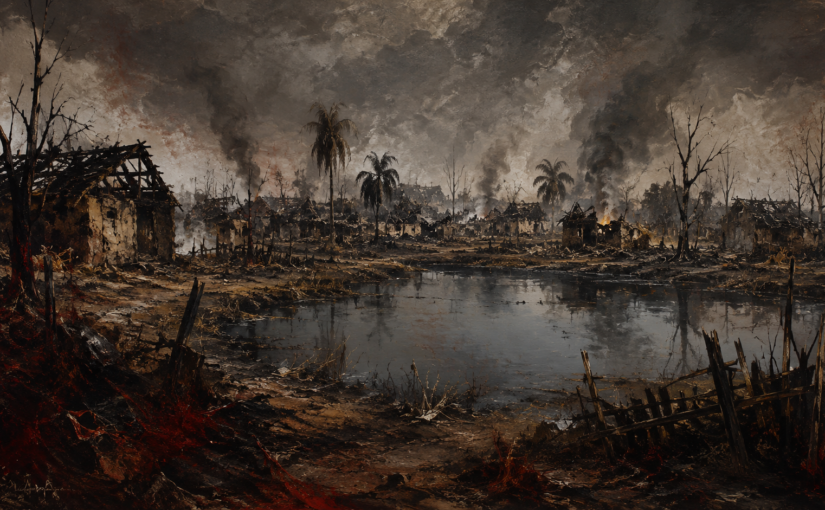
A particularly harrowing element of the report is its account of how people were gathered at Hirun Babu’s pond, then bound and killed. The text describes victims being tied together and thrown into the water, followed by gunfire directed at those struggling, and the pond water turning red with blood while bodies floated “like water hyacinth/কচুরিপানা”. It further states that after the attackers left, local people recovered bodies using nets and buried them in a mass grave on the western bank of the pond, emphasising that families were often unable to perform normal funeral rites due to fear of renewed attacks.
On numbers, the report is careful to show that casualty estimation is contested in local memory and published accounts. It notes that some sources mention 59 named victims, while others cite 69 or 73, and the author concludes that the total number killed in Panchgaon during the nine months of 1971 was “more than one hundred”, although not all names and identities can be recovered. The book also records abductions: it states that 14 people were taken away from the village and their whereabouts remain unknown.
The perpetrators are presented as a combined apparatus of occupation violence: the Pakistan Army as the primary killing force, with local collaborators operating as facilitators and co-perpetrators through identification, guiding troops, and participating in arson, rape, and looting. The report names Alauddin Chowdhury as a principal local organiser and lists additional collaborators and peace committee figures, illustrating how genocidal violence at village scale depended on local networks, not only external troops.
The genocide linkage the book makes is essentially about patterned civilian targeting and group-destructive intent. It portrays Panchgaon as targeted not because it was a battlefield, but because it was a community marked as politically and religiously “suspect”, with violence designed to destroy safety, property, dignity, and the possibility of remaining in place. By documenting the killing method, the disposal of bodies, the mass grave, the contested but substantial death toll, and the role of collaborator structures, Panchgaon Genocide functions as a micro-history of the wider 1971 Bangladesh Genocide, showing how large processes of extermination and persecution were enacted through local geography and local complicity.