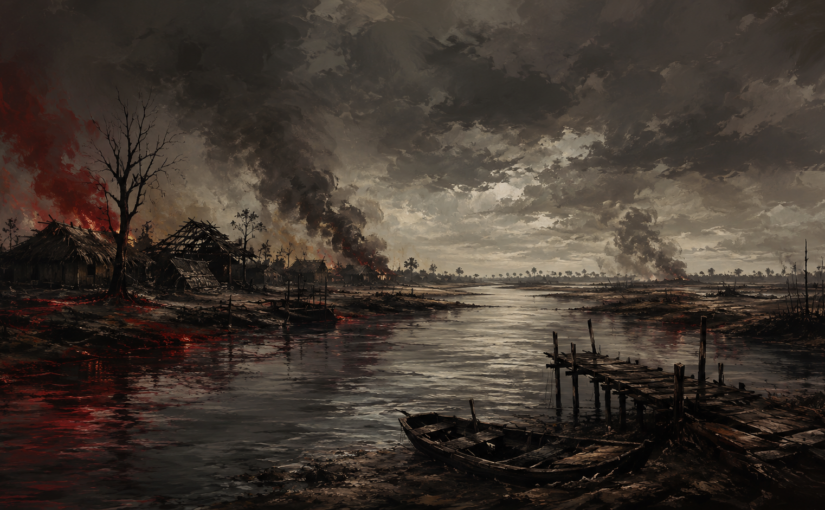
Deara Genocide (Bengali: দেয়াড়া গণহত্যা) is a place-based documentation volume in the Genocide-Torture Index series. It is written by Gouranga Nandi and published in March 2015 by the 1971: Genocide-Torture Archive & Museum Trust.
The report situates Deara within Dumuria Upazila, Khulna, mapping the locality and explaining why this riverine frontier became vulnerable in 1971. It links local violence to the wider occupation strategy: once Pakistani forces established control in Khulna and surrounding thanas, attacks were not confined to urban centres. Villages, river routes, and transit corridors became spaces where civilians were hunted, robbed, and killed, often with the assistance of locally organised collaborator networks.
A key early episode described in the narrative concerns the escalation of violence in mid-April 1971, when Pakistani forces attacked nearby localities and civilians began to flee towards India by boat along river routes. The report highlights how such attacks immediately created refugee flows, and how the prospect of escape itself became dangerous, with communities forced to abandon homes and assets under fear of further raids.
The report then explains the consolidation of collaboration in the Khulna region. It describes the formation and expansion of “peace committee” and Razakar structures, alongside Muslim League-aligned organising, with the stated effect of intensifying looting, targeted intimidation, and the identification of pro-liberation individuals. In this account, collaborators are not portrayed merely as passive sympathisers; they are presented as operational enablers, helping to identify targets, organise raids, and strengthen the machinery of persecution at village level.
The central atrocity documented is the 27 August 1971 massacre in Deara. The report includes a section titled “Shahid shonakto-koron o porichoy” (identification and introduction of martyrs), listing 14 named victims from Deara (Dumuria) who were killed in this episode. It also notes that survivors and families have continued to seek justice and recognition, even as many names and details have been difficult to recover after decades of fear, displacement, and silence.
Taken together, Deara Genocide links local atrocities to a broader genocide narrative through pattern and purpose. The violence described is directed at civilians, enabled by organised collaboration, and embedded in a wider campaign of terror and persecution that sought to destroy the safety and continuity of targeted communities. By naming victims, mapping place, and recording the mechanics of collaboration and flight, the report helps anchor the 1971 Bangladesh Genocide in specific local geographies where the destruction was enacted and where its consequences remain visible today.