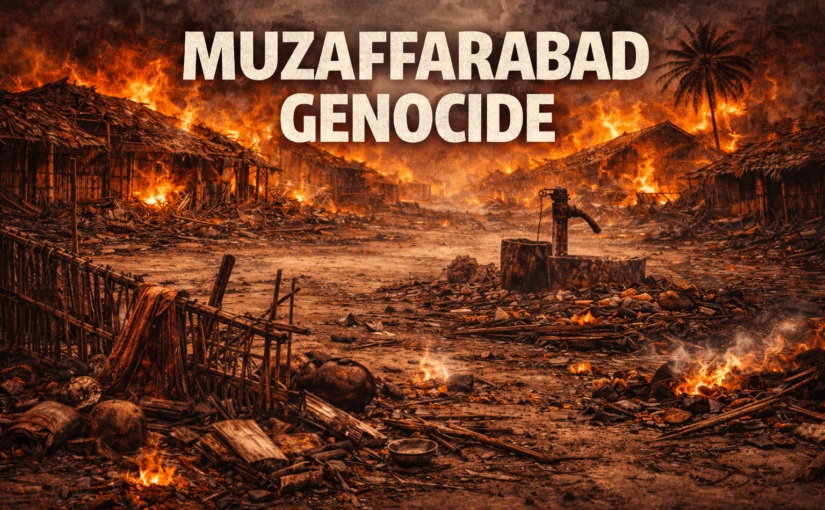
Muzaffarabad Genocide, Chattogram

Muzaffarabad Genocide was written by Chowdhury Shahid Kader and published in December 2014 as part of the series 1971: Genocide-Torture Directory (volume 4). It was produced under the umbrella of the 1971: Genocide-Torture Archive & Museum Trust, with series editorship credited to Professor Muntassir Mamoon.

The report documents the destruction of Muzaffarabad village (Patia Upazila, Chattogram), presenting it as an emblematic episode within the wider 1971 genocidal campaign. It describes Muzaffarabad as a highly educated, socially organised rural settlement that became militarily vulnerable after the Pakistani takeover of the broader Patia area in mid-April 1971. The narrative stresses how rumours and allegations were circulated to portray the village as a fortified base of resistance, which then served as a pretext for a punitive operation.

According to the text, on 3 May 1971 Pakistani forces, aided by local Razakar collaborators, surrounded Muzaffarabad and carried out an assault lasting roughly eight hours. The report states that approximately 300 villagers were killed, around 600 homes were set on fire, and approximately 200 women were subjected to sexual violence. It depicts killings as systematic and often intimate, including executions after people were dragged out from hiding places, alongside arson attacks that trapped families inside burning houses.

Critically, the report frames the violence as targeted group destruction rather than collateral damage. It notes that the village was predominantly Hindu (with only a very small number of Muslim households), and it repeatedly foregrounds how victim identification operated through religion and political labelling (“Hindu” and “Awami League supporter”) to justify murder, sexual violence, and dispossession. In that sense, the Muzaffarabad case is presented as a localised but structurally revealing instance of genocidal violence: central military force applied with local collaboration, driven by a logic of group elimination, terror, and the deliberate unmaking of community life through killing, rape, and mass arson.
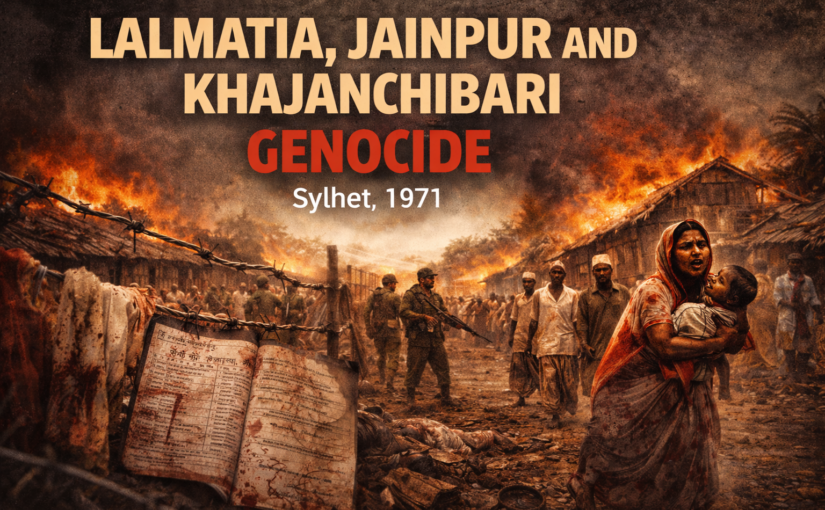
Lalmatia, Jainpur, and Khajanchibari Genocide in Sylhet

Overview

Lalmatia, Jainpur, and Khajanchibari Genocide (Bengali: লালমাটিয়া, জৈনপুর, ও খাজাঞ্চি বাড়ি গণহত্যা) is a short, site-based documentation by Tapan Palit, published by the 1971: Genocide-Torture Archive & Museum Trust in collaboration with the Bangladesh History Congress. The imprint page lists the publication time as December 2014.

What happened

The report reconstructs how the Pakistan Army’s occupation of Sylhet rapidly expanded into a system of killing, detention, looting, and rape across multiple neighbourhoods and nearby localities. It describes Lalmatia as a recurring execution site: civilians were brought from the city and surrounding areas, bound and controlled, and then killed and disposed of to conceal evidence. The account repeatedly stresses the routine nature of the violence, not a single isolated massacre.

Where the report gives indicative figures, it notes that people were often brought in groups of around 5–6 per day, with some days involving 10–12 people. The text also records widespread looting and references sexual violence, but it does not provide a single verified total for rape survivors across these sites.

Who was targeted

The victims were primarily unarmed civilians. The report presents targeting as both political and identity-based: people suspected of supporting the liberation struggle were at high risk, and minorities were also vulnerable in the broader Sylhet campaign. It also shows how terror worked socially: once killings and abductions became predictable, families fled, neighbourhoods fell silent, and community life collapsed under fear.

Why this constitutes genocidal violence

This report matters because it illustrates the mechanics of genocidal violence at local scale. First, killings are described as systematic and repeated, with a stable method (capture, transport, execution, disposal), which points away from “battlefield accident” and towards an organised civilian-targeting practice. Second, the report emphasises the integration of mass killing with persecution: looting, intimidation, detention spaces, and sexual violence functioned together to destroy security, livelihoods, and the possibility of normal life for targeted groups.

Key locations

  • Lalmatia (Dakshin Surma area, Sylhet): presented as the primary killing ground and a recurring execution site.
  • Jainpur: described as a linked locality affected by the same pattern of raids, intimidation, and killings.
  • Khajanchibari (Nayasarak, Sylhet city): recorded as an urban site where civilian-targeting violence occurred, reinforcing that atrocities were not confined to rural spaces.