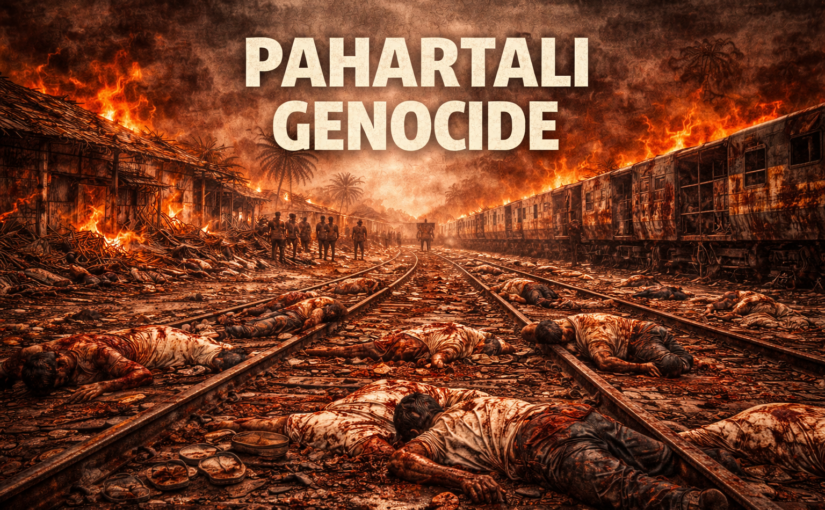
Pahartali Genocide (Genocide-Torture Index series, no. 9) is written by Chowdhury Shahid Kader and was published in December 2014 under the “1971: Genocide-Torture Archive & Museum Trust”, in association with the Bangladesh History Congress. The book reconstructs one of the most infamous killing grounds of 1971 in Pahartali, Chattogram, presenting Pahartali not as an isolated episode of wartime brutality, but as a concentrated site where occupation violence, local collaboration, and targeted destruction of Bengali lives converged.
The core claim is stark: around ten thousand people were killed in and around the Pahartali killing ground during the Liberation War period, with the book highlighting 10 November 1971 as a peak day of slaughter when around 400 people were killed. It describes how victims were seized from surrounding neighbourhoods and from trains passing through the area, then taken to the killing site. A significant portion of those targeted were ordinary civilians, including railway employees and residents of nearby railway colonies, which the book portrays as a deliberate strategy of terror designed to break Bengali community life and remove perceived “pro-liberation” social bases.
The narrative also documents sexual violence as an organised component of atrocity. It describes the occupation’s use of a seized building as a torture and detention centre where women were held and repeatedly raped, and it records the author’s estimate of around one thousand “Birangona” or War Heroines linked to the Pahartali atrocity landscape. This coupling of mass killing with gendered violence is presented not as incidental misconduct, but as part of an intentional pattern of domination and collective humiliation of Bengalis, with long after-effects for survivors and families.
In linking these events to genocide, the book’s reasoning is essentially about pattern and purpose: the violence is portrayed as planned, repeated, and systematic, facilitated by the Pakistani forces and enabled by local collaborators, with victims selected because they were part of the Bengali population and its social institutions in a strategically important urban-industrial zone. It also shows how memory and justice remain contested, noting struggles over protection of the killing ground and the politics of recognition, which the author frames as an extension of the harms inflicted in 1971 into the present.