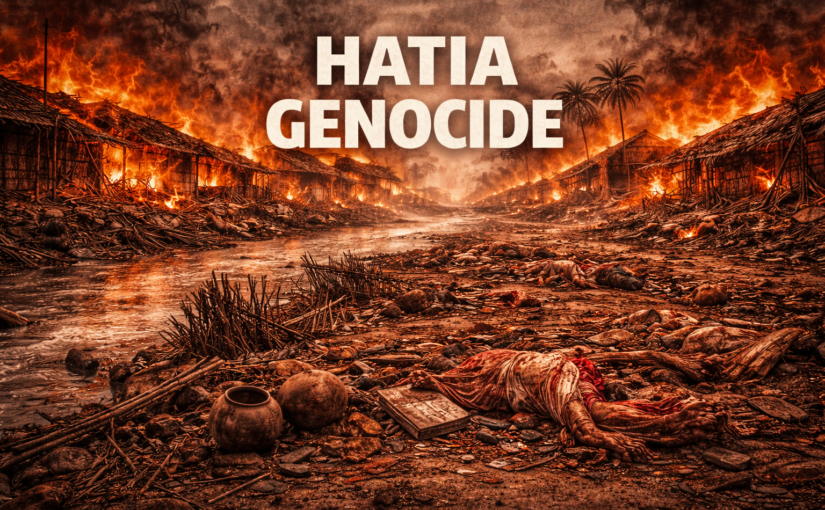
Hatia Genocide (Genocide-Torture Index series, Vol. 12) is written by Mitun Saha and published in March 2015 under the “1971: Genocide-Torture Archive & Museum Trust” in association with the Bangladesh History Congress. The book documents a large-scale massacre and associated atrocities carried out during the 1971 Liberation War, focusing on Hatia Union and neighbouring localities in Ulipur, Kurigram.
At the core of the account is the 13 November 1971 attack, described as a sustained operation lasting roughly ten hours, in which Pakistani forces and local collaborators (including Razakars) assaulted multiple villages, including Dagarkuti, Anantapur, Baguya, Ramkhana, Noyadora, Nilkantha, and nearby areas. Based on the information compiled in the book, at least 697 unarmed civilians were killed. The narrative further records severe brutality, including systematic torture and sexual violence against women, framed as widespread and repeated rather than incidental.
The book’s argument links these crimes to genocide by emphasising intent and pattern: the violence is presented as targeted against the local population because of its perceived alignment with Bengali nationalism and its support for the liberation struggle, with repression extending beyond battlefield confrontation into village life. It also notes how such attacks were enabled by collaboration networks that operated alongside the occupying forces, which is important for understanding how genocidal campaigns work at the local level, through identification, pursuit, and coordinated participation.
Finally, Hatia Genocide is also a critique of forgetting. It notes that, despite the scale of loss and the existence of mass killing sites across Bangladesh, many local genocidal episodes remain under-discussed in national narratives and mainstream documentation. By assembling place-based history, survivor and witness accounts, and named locations, the book positions Hatia not as an isolated tragedy, but as one documented example of a broader genocidal campaign carried out in 1971 by the Pakistan Army and its collaborators.