This site assembles verifiable sources on the 1971 Bangladesh Genocide to support research, education, and public understanding. It foregrounds survivor voices, preserves contested evidence, and counters denial with transparent methods and citations.
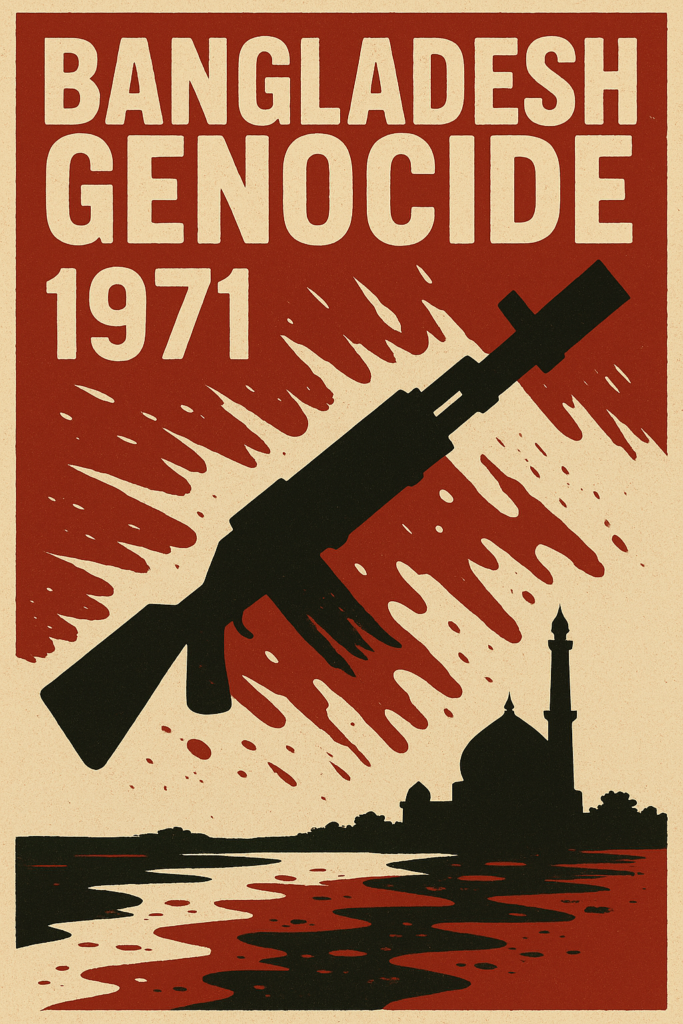
What do we mean by “genocide”?
Genocide is not just a terrible word; it’s a specific crime under international law. In simple terms, it means acts like killing, causing serious bodily or mental harm, or creating life-destroying conditions done with the intent to wipe out, in whole or in part, a group defined by nationality, ethnicity, race, or religion.
Applied to 1971, the question is: Were Bengalis (as a national group) and Hindus (as a religious group) deliberately targeted to destroy them, at least in part? The answer, based on contemporaneous records and later testimonies, is yes.
What happened in 1971?
On the night of 25–26 March 1971, Pakistan’s army launched a country-wide crackdown in what was then East Pakistan (today Bangladesh). The operation started in the capital, Dhaka, and rapidly spread.
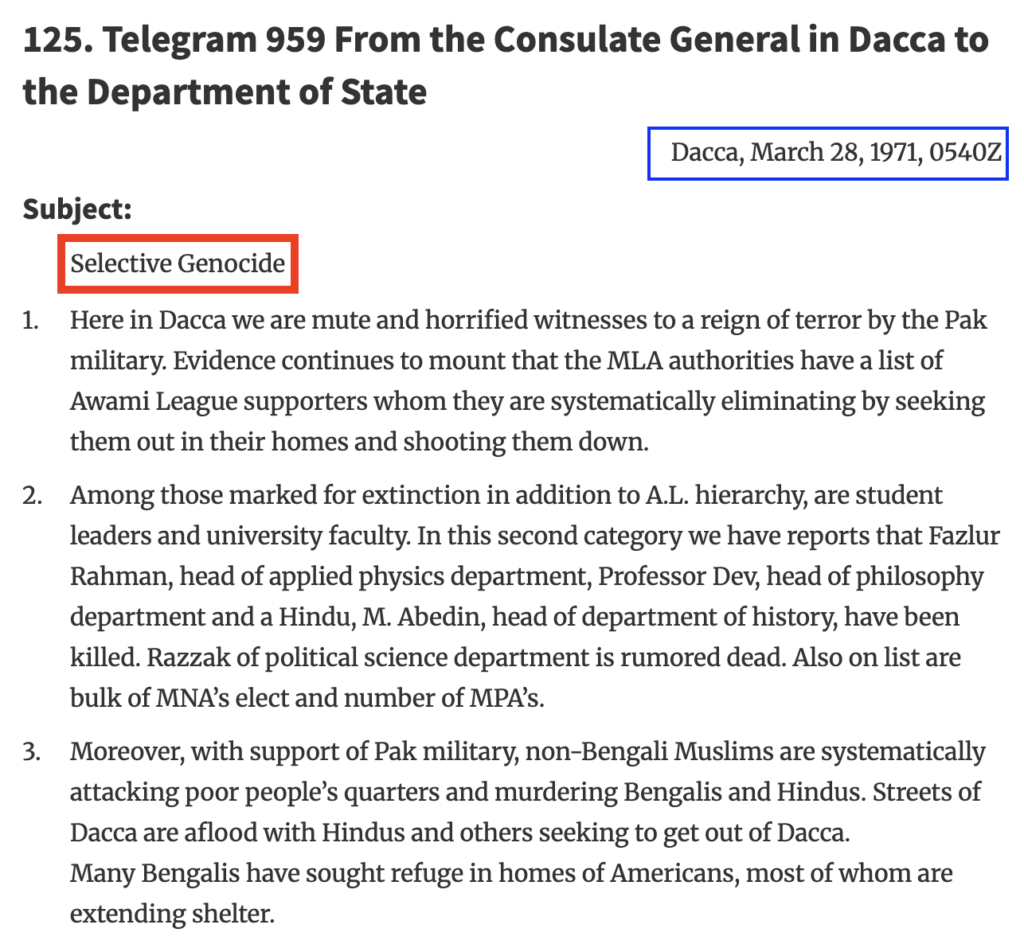
- Lists and round-ups: Soldiers used prepared lists to find and kill people at their homes—political organisers, student leaders, professors, journalists, and elected representatives.
- University attacks: Dhaka University, the heart of civic life, was assaulted. Students were shot in their rooms or gunned down in groups. Women fleeing a dormitory set on fire were machine-gunned.
- Hindus singled out: Hindu neighbourhoods and temples were attacked and burned. Reports at the time said Hindus were a “special focus” of the brutality.
- Sexual violence as a weapon: Women were raped systematically—in homes, in camps, and during raids. This was not random; it was used to terrorise families and tear communities apart.
- Curfews used as cover: Night-time curfews were imposed and then exploited to conduct search-and-destroy raids, even in areas where there was no fighting.
- Forced flight: Villages were shelled or burned. Millions of people fled to India to escape the violence and starvation that followed.
These are not the normal tragedies of war. They show a pattern: organised, identity-based attacks designed to cripple the Bengali people as a nation and to drive out or destroy the Hindu minority.
Who was targeted—and why that matters
- Bengalis (national group): The intention was to break the back of Bengali society by decapitating its leadership—students, teachers, writers, civil servants, and elected leaders—so the group could not reproduce its political and cultural life. Destroying a group’s “head and heart” is a classic way genocides proceed “in part”.
- Hindus (religious group): Hindus were targeted as Hindus—their areas marked, homes torched, and families driven out. Religion is explicitly protected under the legal definition of genocide, so this targeting alone already meets the threshold.
“But wasn’t it a civil war?”
There was armed conflict later in the year, including a war between India and Pakistan in December 1971. But the earliest phase in March–April—and much that followed—was not battle between soldiers. It was state violence against civilians, defined by who people were (Bengali, Hindu, student, intellectual), not what they had done.
Key points that cut through the “civil war” excuse:
- House-to-house executions and temple burnings are not military necessity.
- Machine-gunning unarmed students and raping women at scale are crimes of intent, not accidents of combat.
- In many places, no resistance was offered when the round-ups began; people were attacked because of their identity, not because they were fighting.
How do we know this?
We have unusually strong evidence because many documents were written as events unfolded:
- Diplomatic cables and eyewitness reports from March–April 1971 describe “selective genocide,” “reign of terror,” and the use of lists to hunt people down.
- Reports identify Hindu areas and a temple district being torched, with prisoners trucked to camps.
- Early casualty counts—limited to Dhaka—already ran into the thousands within days; across the year, millions fled to India.
- Post-war Pakistani sources (including material compiled around the Hamood-ur-Rahman Commission) discuss command decisions, the use of auxiliary forces, and the overall collapse—narratives that, read alongside eyewitness evidence, confirm the breadth and intent of the violence.
No single document has to “prove” everything. The convergence of independent sources—field reports, survivor testimony, and insider accounts—builds a clear picture that meets the legal test.
What exactly makes it genocide?
Genocide has two pillars: what was done (the acts) and why it was done (the intent).
The acts were there:
- Killing on a mass scale (urban massacres, village raids, executions).
- Serious bodily and mental harm (systematic sexual violence, torture, public terror).
- Life-destroying conditions imposed on communities (burned homes, starvation, mass flight).
The intent was there too:
- Selection by identity (Bengali and Hindu) and by role (student, professor, elected leader).
- Decapitation of leadership, which is how perpetrators destroy a group “in part”.
- Contemporaneous labels by neutral observers (“selective genocide”) and descriptions of a campaign “aimed at eliminating the core of future resistance”—language of purpose, not accident.
Put simply: who was attacked, how, and in what pattern shows a plan to destroy parts of the Bengali nation and the Hindu community. That is genocide.
Why recognition stalled then—and why it matters now
In 1971, some powerful governments knew what was happening but chose not to press the perpetrators, for geopolitical reasons (especially the Cold War and the opening to China). That political caution helps explain the lack of formal international recognition at the time. It does not change the facts or the law.
Recognition now is not about re-fighting old battles; it is about:
- Truth: acknowledging what survivors lived through.
- Justice: setting the record straight against denial and distortion.
- Prevention: learning the warning signs—identity-based dehumanisation, “lists”, leadership decapitation, sexual violence—so they are recognised and stopped elsewhere.
Myths, briefly answered
- “Casualty numbers are disputed, so it can’t be genocide.” Genocide is about pattern and intent, not a single number. Even the most conservative early counts and the millions who fled confirm the scale.
- “Only extremists were targeted.” Whole categories were targeted: Hindus, students, professors, journalists, elected representatives, and poor Bengali neighbourhoods.
- “It was a domestic matter.” No state has a “right” to destroy its own people. That is precisely why genocide is a crime under international law.
In short
The 1971 Bangladesh Genocide was a list-driven, identity-marked campaign of killing, terror, and expulsion. It targeted the Bengali national community—especially its leaders and future leaders—and the Hindu religious minority. The method was systematic: night curfews, house-to-house raids, sexual violence, temple burnings, and forced displacement on an immense scale. The goal was to break and destroy parts of these groups. That is why it meets the definition of genocide.